
Technology newsroom
Unexpected! OpenAI Selects AMD EPYC Turin to Host 'Jalapeño' AI Chip, Citing Nvidia Vera's Immaturity
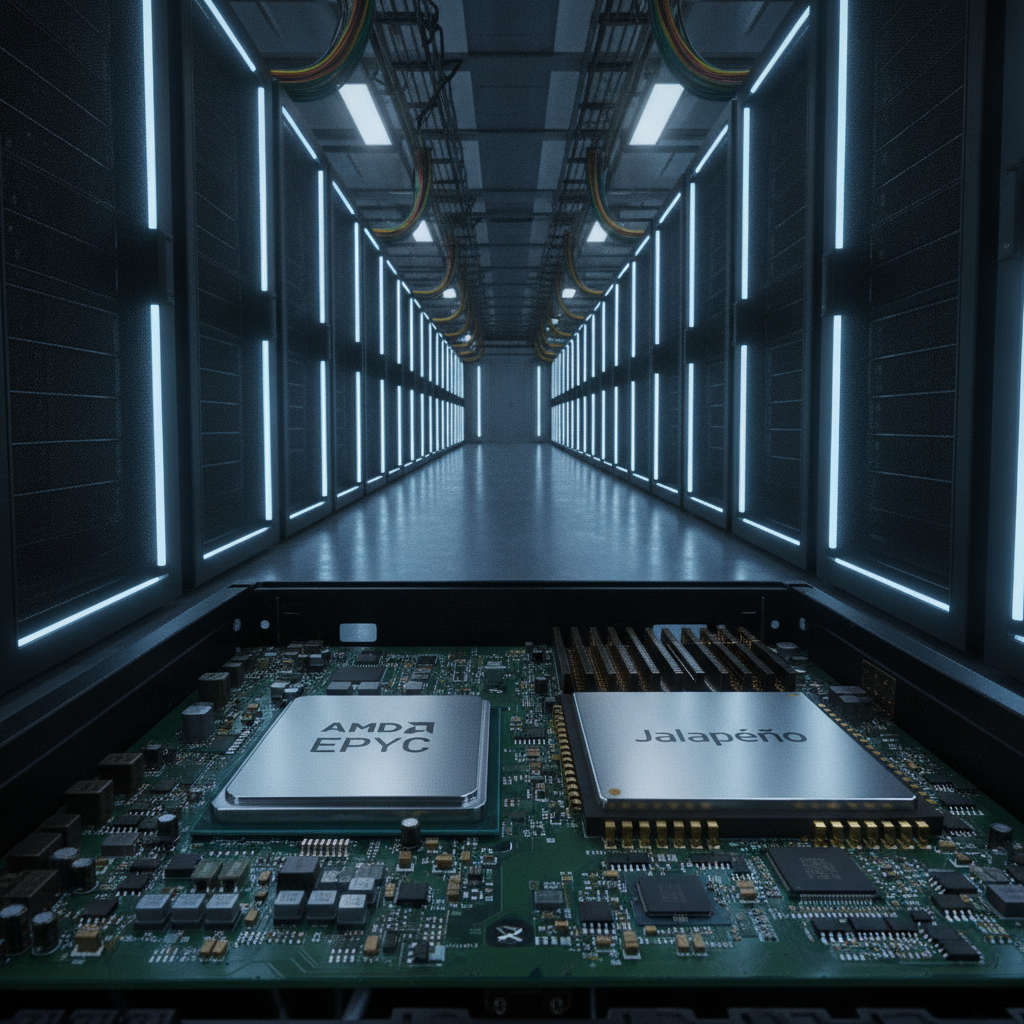
OpenAI surprised the industry by choosing AMD EPYC Turin CPUs as the main host for its self-developed AI chip, Jalapeño, citing practical reasons that AMD's platform is currently more stable and mature than Nvidia Vera.
📌 Key Takeaways:
- OpenAI confirmed its choice of AMD EPYC Turin CPUs as the main host for its internally designed Jalapeño ASIC AI chip.
- Richard Ho, OpenAI's VP of Hardware, explained that this was a pragmatic decision to mitigate risks, as Nvidia Vera CPUs still lack the desired level of maturity and stability.
- The choice of a proven x86 platform like Turin reflects an emphasis on system reliability and readiness, despite OpenAI's close relationship with Nvidia.
OpenAI has once again surprised the technology industry by revealing that its self-designed ASIC AI processor chip, named Jalapeño, will be deployed with a host system using AMD EPYC Turin CPUs, complete with a large memory capacity of up to 1.5TB per host. This decision runs counter to many expectations that OpenAI would likely choose a solution from its close partner, Nvidia.
⚙️ Behind the Strategic Decision
Richard Ho, Vice President and Head of Hardware at OpenAI, gave an exclusive interview to Tom's Hardware regarding the reasons behind choosing AMD EPYC Turin, stating that it was a pragmatic decision to de-risk the project. He noted, "Vera (Nvidia's CPU) in standalone form is still a bit behind in terms of maturity level." In contrast, AMD's Turin CPUs are robust and fully meet the team's requirements, and OpenAI's partners already have experience with this platform.
Ho emphasized that for the Jalapeño program, the primary goal is to create a high-performance, cost-effective chip, while simultaneously avoiding unnecessary risks. The choice of Turin, therefore, was a suitable option within the company's decision-making framework.
🆚 x86 vs. Arm Architecture Battle
This decision also reflects the competition between the x86 architecture, which has long dominated the server market, and the rising Arm (AArch64) architecture in the AI era. Although Nvidia heavily promotes its Arm-based Vera CPU, claiming up to 1.8 times better performance than competitors in some tests (but only 3% better overall), the x86 architecture still boasts significantly greater maturity and a more robust ecosystem.
Another factor is the physical difference: Turin is a socketed CPU, which is easier to swap out, whereas Vera is board-mounted, offering less flexibility for maintenance. While OpenAI will continue to explore the use of Vera and Arm AGI in the future, for the initial widespread deployment of Jalapeño, choosing a stable and proven platform like AMD EPYC Turin is currently the safest and smartest option.
💬 Do you think OpenAI's decision to use AMD EPYC Turin instead of waiting for Nvidia Vera is the right move? Or is this merely a temporary risk mitigation?