
WinPOPBit Aims to Boot Windows 11 on Older Processors via Kernel Patches
Technology news
According to Help Desk Geek, the experimental open-source patcher WinPOPBit modifies core Windows binaries to bypass SSE4.2 checks, but still requires hardware POPCNT support and disabled boot integrity checks.
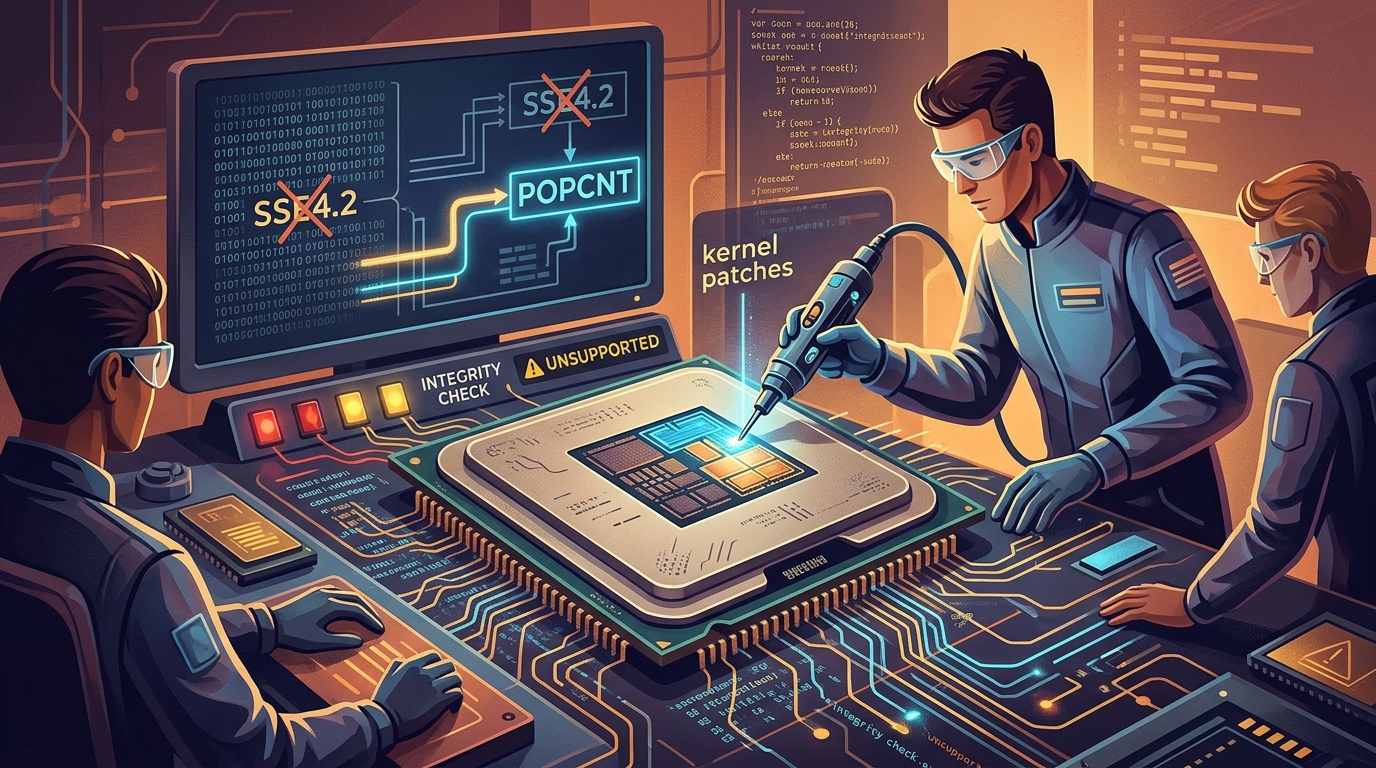
Key Findings and Documented Targets of WinPOPBit
As reported by Help Desk Geek on November 22, 2026, the experimental MIT-licensed project WinPOPBit aims to enable Windows to boot on selected aging processors that standard Microsoft setup routines reject. The project's README lists tested hardware including an AMD Athlon II, a VIA Nano, and a 2002 Intel Pentium 4 "Northwood". Additional coverage from Neowin, Pureinfotech, and PCWorld highlights related fixes, such as workarounds for hangs on systems without usable HPET timers (notably Nvidia nForce chipsets) and planned patches for Prescott Pentium 4, Smithfield Pentium D (LGA 775), and AMD K8 families.
Technical Implementation and Binary Patching Mechanics
Passing setup validation and executing Windows instructions represent two distinct hurdles. Tools like Rufus can bypass TPM and Secure Boot deployment requirements, but cannot supply missing processor instructions. Beginning with Windows 11 build 24H2, Microsoft's boot process enforces checks for both POPCNT and SSE4.2 instructions.
According to the WinPOPBit README, Windows binaries rarely execute SSE4.2 code directly. Rather than emulating the instruction, the patcher modifies core system files—specifically the kernel (ntoskrnl.exe) and boot loader (winload.exe / winload.efi)—to alter processor feature detection and skip the SSE4.2 check. For processors lacking SSE4.1, the tool replaces two system DLLs with versions from Windows 11 23H2 to prevent installer crashes.
Practical Hardware Applicability and Verification Scope
The patcher does not add hardware instructions. The README explicitly confirms that processors lacking POPCNT, such as Intel Core 2 chips, cannot run Windows 11 under this method. Furthermore, as of November 21, 2026, the project's GitHub Releases section remained empty, leaving the commit history and README as the primary references.
Users evaluating spare hardware must verify their exact processor model and OS build via Settings > System > About against specific patch notes. A shared motherboard socket does not establish compatibility across chip revisions, and peripherals, graphics drivers, and firmware sleep/resume behavior require standalone evaluation.
Security Trade-Offs and OS Lifecycle Limitations
Deploying WinPOPBit incurs significant security drawbacks. The README's installation procedure mandates disabling boot-time driver signature verification (nointegritychecks), removing a core defense mechanism Windows normally relies on to block unverified files. Unofficial modifications may also impair Windows Update stability and enterprise manageability.
The project is not endorsed by Microsoft, and no independent long-term stability data exists. Relying on older Windows fallbacks also carries lifecycle constraints: mainstream Windows 10 support ended on October 14, 2025 (with Extended Security Updates carrying paid or enrollment-specific conditions). Meanwhile, Windows 11 23H2 Home and Pro editions ended updates in November 2025, and Enterprise and Education editions reached end-of-servicing on November 10, 2026.
Source: helpdeskgeek.com (https://helpdeskgeek.com/winpopbit-windows-11-20-year-old-processors/)